
Meta Platforms Inc. Stock Analysis
Comprehensive Factor-Based Investment Review - October 10, 2025

Executive Summary
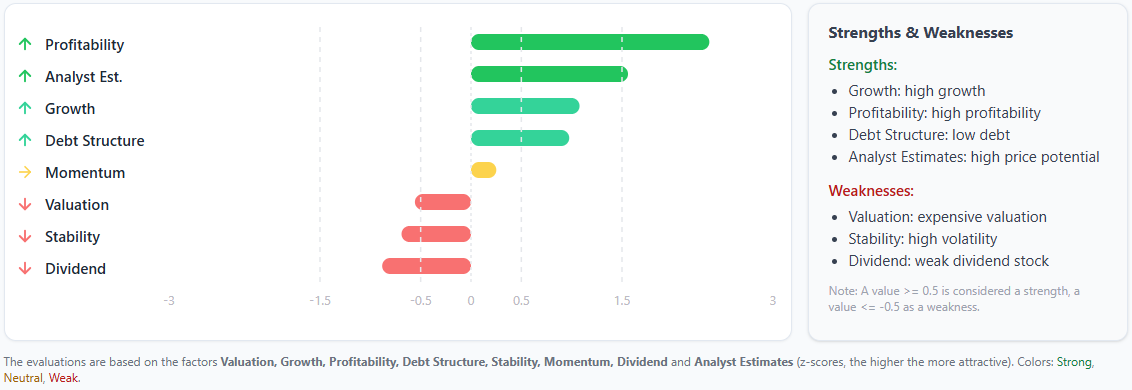
Meta Platforms Inc. (META) presents a compelling growth and profitability profile with strong fundamental characteristics, balanced against valuation and stability concerns. The company demonstrates very strong profitability (z-score: 2.37) with exceptional margins and returns, combined with very strong analyst support (z-score: 1.56) projecting 22% upside potential. Meta also offers strong growth prospects (z-score: 1.08) and a strong debt structure (z-score: 0.98), providing financial flexibility for continued investments in AI and metaverse initiatives. However, these strengths are tempered by weak valuation metrics (z-score: -0.56), weak stability characteristics (z-score: -0.69), weak dividend income (z-score: -0.88), and neutral momentum (z-score: 0.25). Investment Thesis: Meta represents a high-quality growth investment with exceptional profitability and strong institutional backing, suitable for investors seeking exposure to digital advertising, artificial intelligence, and social media platforms with tolerance for moderate volatility.
Factor Analysis Overview
This analysis employs an 8-factor quantitative framework to evaluate Meta’s investment merit. Each factor is scored using z-scores, which measure how many standard deviations a company’s metrics deviate from the market average. The interpretation framework is as follows:
z-score > 1.5 = Very Strong performance relative to peers
z-score 0.5 to 1.5 = Strong performance relative to peers
z-score -0.5 to 0.5 = Neutral performance
z-score -1.5 to -0.5 = Weak performance relative to peers
z-score < -1.5 = Very Weak performance relative to peers
All underlying metrics are normalized (z-transformed) to enable meaningful cross-company comparisons within the U.S. equity market.
Detailed Factor Breakdown
Note: As a premium subscriber, you gain access to our powerful web dashboard where all the analysis comes to life (also the following analysis of META):
3.1 Profitability Analysis: Very Strong
Factor Score: 2.37 | Rating: Very Strong
Overview: Profitability metrics evaluate Meta’s efficiency in converting revenue into profits and generating returns on invested capital. Very strong profitability characteristics indicate exceptional operational effectiveness, pricing power, and business model sustainability that significantly exceed market averages.
Key Metrics:
Return on Assets: 24.3% - Very Strong → Interpretation: Meta generates exceptional returns exceeding 24% on its asset base, demonstrating highly efficient capital utilization and the asset-light nature of its digital advertising and social media platform business model.
Return on Equity: 39.3% - Strong → Interpretation: The company delivers nearly 40% returns to shareholders on their equity investment, an outstanding figure that reflects Meta’s ability to generate substantial profits relative to shareholder capital and efficient use of leverage.
Net Profit Margin: 40.0% - Very Strong → Interpretation: Meta converts an exceptional 40% of revenue into net income, demonstrating tremendous pricing power, operating leverage, and the highly profitable nature of digital advertising when operating at scale.
Return on Invested Capital: 27.0% - Very Strong → Interpretation: The 27% ROIC indicates Meta generates exceptional returns on all capital deployed in the business, significantly exceeding cost of capital and demonstrating sustainable competitive advantages.
Investment Implication: Meta’s profitability profile represents the cornerstone of its investment appeal, with the very strong z-score of 2.37 placing it among the most profitable companies in the U.S. market. The exceptional 40% net margin reflects the inherent profitability of digital advertising at scale, where incremental users and engagement drive revenue growth with minimal marginal costs. The outstanding ROE near 40% and ROIC of 27% demonstrate Meta’s ability to generate substantial returns on invested capital, far exceeding typical hurdle rates and cost of capital. For investors, these metrics confirm Meta operates a highly sustainable business model with durable competitive advantages stemming from network effects, massive user bases across Facebook, Instagram, and WhatsApp, and unparalleled targeting capabilities. The very strong profitability provides substantial cash generation to fund AI investments, Reality Labs development, shareholder returns, and strategic acquisitions while maintaining financial strength.
3.2 Analyst Estimates Analysis: Very Strong
Factor Score: 1.56 | Rating: Very Strong
Overview: This factor captures Wall Street’s collective assessment of Meta’s investment prospects, incorporating both price target expectations and recommendation consensus. Very strong analyst sentiment reflects exceptional institutional confidence in the company’s business model, growth trajectory, and competitive positioning.
Key Metrics:
Price Potential: 22.0% - Strong → Interpretation: The average analyst price target implies over 22% upside from current trading levels, indicating professional investors believe Meta shares offer substantial appreciation potential relative to fundamental prospects.
Analyst Rating: 1 - Very Strong → Interpretation: Meta receives top-tier recommendations from the analyst community, with a rating of 1 indicating overwhelming “Buy” or “Strong Buy” consensus across covering analysts, reflecting strong conviction in the company’s outlook.
Investment Implication: The analyst sentiment provides powerful institutional validation for Meta’s investment case, with the very strong z-score of 1.56 indicating exceptional professional support. The combination of 22% upside potential and near-unanimous buy ratings reflects Wall Street’s confidence in multiple growth drivers: digital advertising market share gains, AI-powered ad targeting improvements, Reels monetization acceleration, WhatsApp business opportunities, and potential metaverse breakthroughs. The very strong analyst factor is particularly meaningful given Meta’s large market capitalization and extensive coverage—achieving such consensus among numerous independent research teams suggests high confidence in management’s strategic direction following the efficiency improvements and AI investments of recent years. For investors, this strong analyst support indicates reduced downside risk and provides a quantitative framework for expected returns, with professional models suggesting substantial appreciation potential from current levels.
3.3 Growth Analysis: Strong
Factor Score: 1.08 | Rating: Strong
Overview: The Growth factor evaluates Meta’s ability to expand its business operations and increase shareholder value over time. This encompasses historical revenue and earnings performance as well as forward-looking analyst projections. Strong growth characteristics indicate above-average expansion through user growth, engagement increases, and monetization improvements.
Key Metrics:
Revenue Growth: 8.6% - Strong → Interpretation: Meta maintains solid high-single-digit revenue growth, demonstrating the company’s ability to expand its advertising business despite its massive scale, reflecting continued user engagement, improved ad targeting, and Reels monetization progress.
Earnings Growth: 3.3% - Strong → Interpretation: Earnings growth trails revenue expansion slightly, reflecting ongoing investments in AI infrastructure, Reality Labs development, and efficiency initiatives that temporarily impact near-term profit growth rates.
Projected Earnings Growth: 14.8% - Neutral → Interpretation: Analysts forecast moderate earnings acceleration to nearly 15%, suggesting expectations for improved operational leverage as AI investments drive engagement, ad effectiveness improves, and Reality Labs losses moderate.
Investment Implication: Meta’s growth profile demonstrates strong expansion characteristics despite the company’s enormous scale with nearly 4 billion users across its family of apps. The strong z-score of 1.08 places Meta above market averages for growth, impressive for a company generating over $150 billion in annual revenue. The 8.6% revenue growth reflects Meta’s continued ability to increase monetization through improved ad targeting powered by AI, Reels adoption and monetization, WhatsApp business messaging opportunities, and share gains from traditional media advertising budgets. The projected 15% earnings acceleration suggests that ongoing efficiency initiatives and AI investments will translate into margin expansion and profit growth outpacing revenue. For growth investors, Meta offers compelling exposure to digital advertising secular trends, artificial intelligence applications in content recommendation and ad targeting, and optionality on metaverse development—all backed by exceptional profitability that funds continued innovation.
3.4 Debt Structure Analysis: Strong
Factor Score: 0.98 | Rating: Strong
Overview: The Debt Structure factor assesses Meta’s leverage and financial risk profile by examining debt relative to various measures of company size and asset base. Strong debt characteristics indicate conservative balance sheet management and substantial financial flexibility.
Key Metrics:
Debt/Market Cap: 2.8% - Strong → Interpretation: Meta’s debt represents less than 3% of its market capitalization, indicating minimal leverage relative to enterprise value and providing exceptional financial flexibility for strategic investments, acquisitions, or shareholder returns.
Debt/Equity: 25.4% - Neutral → Interpretation: With debt at 25% of shareholder equity, Meta maintains modest leverage within conservative ranges, balancing the benefits of low-cost debt financing with financial independence and flexibility.
Debt/Assets: 16.8% - Strong → Interpretation: Only 17% of Meta’s assets are financed through debt, demonstrating conservative balance sheet management with substantial unencumbered assets and strong coverage for creditors.
Investment Implication: Meta’s debt structure exemplifies financial conservatism for a highly profitable technology company, with the strong z-score of 0.98 indicating balance sheet strength that exceeds market norms. The minimal debt-to-market-cap ratio provides extraordinary financial flexibility for multiple strategic priorities: substantial capital expenditures on AI infrastructure and data centers (estimated $30-40 billion annually), continued Reality Labs investments despite ongoing losses, opportunistic acquisitions to enhance platform capabilities, and significant shareholder returns through dividends and buybacks. The strong debt profile insulates Meta from interest rate volatility and credit market disruptions while maintaining significant borrowing capacity if needed. For investors, the conservative balance sheet partially mitigates concerns about expensive Reality Labs investments and AI infrastructure spending, ensuring Meta can fund ambitious initiatives without financial strain or shareholder dilution.
3.5 Momentum Analysis: Neutral
Factor Score: 0.25 | Rating: Neutral
Overview: Momentum factors measure Meta’s recent stock price performance across multiple timeframes, capturing market sentiment and technical price trends. Neutral momentum indicates neither strong uptrends nor downtrends, suggesting stable pricing without clear directional conviction.
Key Metrics:
Momentum 3M: -1.4% - Neutral → Interpretation: Meta shares have been essentially flat to slightly negative over the past three months, showing neither significant strength nor weakness in recent trading.
Momentum 6M: 40.8% - Strong → Interpretation: Over a six-month horizon, Meta has delivered solid returns exceeding 40%, indicating positive medium-term price action reflecting market recognition of improving fundamentals.
Momentum 12M: 24.0% - Neutral → Interpretation: The 12-month return of 24% shows respectable appreciation, though the deceleration from six-month momentum suggests recent consolidation or profit-taking after strong earlier gains.
Investment Implication: Meta’s momentum profile indicates a stock in consolidation mode following strong appreciation, with the neutral z-score of 0.25 suggesting average momentum relative to the broader market. The divergence between strong six-month returns (41%) and modest twelve-month returns (24%) indicates Meta experienced significant appreciation in the recent past but has paused or pulled back more recently. The essentially flat three-month performance suggests investors are digesting previous gains, awaiting further catalysts, or concerned about near-term headwinds such as AI infrastructure spending, competitive pressures, or regulatory challenges. For momentum investors, the neutral classification suggests waiting for clearer directional signals before establishing positions. However, for fundamental investors, the consolidation following strong appreciation may represent an attractive entry point, particularly given the very strong profitability, analyst support, and reasonable valuation following any recent pullback.
3.6 Valuation Analysis: Weak
Factor Score: -0.56 | Rating: Weak
Overview: Valuation metrics compare Meta’s market price to underlying fundamental measures of value, including earnings, book value, revenue, and cash flow. Weak valuation characteristics suggest shares trade at premium levels relative to fundamentals, indicating limited margin of safety.
Key Metrics:
Earnings Yield: 4.0% - Neutral → Interpretation: Meta’s earnings yield of 4% (indicating a P/E ratio of approximately 25x) represents a moderate premium that reflects growth expectations and quality characteristics rather than value pricing.
Earnings/Price: 4.1% - Neutral → Interpretation: The 4.1% earnings-to-price ratio confirms the elevated earnings multiple, suggesting neutral value from a traditional earnings perspective given Meta’s growth profile.
Book Value/Price: 10.9% - Weak → Interpretation: Meta trades at approximately 9x book value (1/0.109), a significant premium to net asset value that reflects the market’s valuation of user relationships, data assets, and platform network effects not captured on the balance sheet.
Revenue/Price: 10.0% - Weak → Interpretation: The revenue-to-price ratio indicates a price-to-sales multiple of approximately 10x, elevated for even a high-growth technology company and reflecting premium pricing for Meta’s digital advertising dominance.
Cash Flow/Price: 5.7% - Neutral → Interpretation: Meta generates cash flow equivalent to approximately 6% of its market capitalization annually, providing somewhat better value from a cash generation perspective than pure earnings metrics suggest.
Investment Implication: Meta’s valuation presents a moderate concern, with the weak z-score of -0.56 indicating pricing at a premium to market averages. The P/E ratio around 25x and price-to-sales near 10x suggest much of Meta’s growth potential and competitive advantages are reflected in the current share price. However, the weakness is not extreme—these multiples are justifiable for a company with 40% profit margins, strong growth, and exceptional returns on capital. The premium valuation reflects Meta’s dominant market position in social media and digital advertising, unparalleled user data and targeting capabilities, strong AI integration, and potential optionality on metaverse development. For value-oriented investors, the weak valuation suggests limited margin of safety and indicates better opportunities may exist elsewhere. Growth investors should recognize that future returns will depend on Meta meeting or exceeding high expectations embedded in current valuations, requiring successful AI monetization, continued engagement growth, and eventual Reality Labs commercialization to justify premium multiples.
3.7 Stability Analysis: Weak
Factor Score: -0.69 | Rating: Weak
Overview: Stability metrics assess the volatility and predictability of Meta’s stock price and financial results. Weak stability characteristics indicate above-average volatility that may concern risk-averse investors, though this is common for large-cap technology companies.
Key Metrics:
Volatility 3M: 31.5% - Neutral → Interpretation: Meta’s three-month price volatility of 31.5% indicates moderate-to-elevated fluctuations typical of large-cap technology stocks, reflecting sensitivity to earnings reports, regulatory developments, and competitive dynamics.
Volatility 6M: 39.5% - Weak → Interpretation: Six-month volatility approaching 40% represents elevated price swings that may concern conservative investors but remain within normal ranges for mega-cap technology companies operating in dynamic markets.
Volatility 12M: 36.5% - Neutral → Interpretation: The 12-month volatility metric shows Meta experiencing material price movements over the past year, consistent with market reactions to earnings reports, AI strategy announcements, and Reality Labs investment updates.
Revenue Volatility: 12.6% - Neutral → Interpretation: Revenue fluctuations of 12.6% indicate moderate quarterly performance variability, likely reflecting seasonal advertising patterns, macroeconomic sensitivity, and digital advertising market dynamics.
Earnings Volatility: 6.6% - Weak → Interpretation: Earnings volatility of 6.6% suggests moderate profit unpredictability, reflecting the operating leverage in Meta’s business model where revenue changes amplify into earnings fluctuations.
Investment Implication: Meta’s stability profile reflects typical volatility for a large-cap technology company operating in the dynamic digital advertising market. The weak z-score of -0.69 indicates above-average volatility that may concern risk-averse investors but is not extreme. The elevated price volatility stems from multiple factors: quarterly earnings sensitivity given premium valuation, ongoing Reality Labs losses and investor debate about metaverse investments, regulatory uncertainty around data privacy and platform content moderation, competitive dynamics with TikTok and emerging platforms, and macroeconomic sensitivity of advertising budgets. The moderate revenue and earnings volatility confirms that while Meta’s business experiences quarterly fluctuations, the diversified platform portfolio and massive user base provide some stability. Investors should expect continued price volatility driven by quarterly results, AI strategy execution updates, Reality Labs progress, and regulatory developments. Conservative investors may find the volatility uncomfortable, while growth-oriented investors should view periodic selloffs as potential accumulation opportunities given Meta’s strong fundamentals.
3.8 Dividend Analysis: Weak
Factor Score: -0.88 | Rating: Weak
Overview: The Dividend factor evaluates Meta’s income-generating characteristics for shareholders, including dividend yield and payout sustainability. Weak dividend metrics indicate limited income generation, though this is common for growth-focused technology companies.
Key Metrics:
5Y Avg Dividend Yield: 0.0% - Weak → Interpretation: Meta initiated its dividend only recently (2024), having previously returned capital exclusively through share buybacks, resulting in no historical five-year average yield.
Current Dividend Yield: 0.3% - Weak → Interpretation: Meta’s current dividend yield of just 0.3% provides minimal income to shareholders, reflecting the company’s preference for capital appreciation and buybacks over substantial dividend distributions.
Payout Ratio: 7.3% - Strong → Interpretation: The minimal 7.3% payout ratio indicates Meta distributes only a small fraction of earnings as dividends, retaining the vast majority for investments, acquisitions, and share repurchases while maintaining capacity for substantial dividend growth.
Investment Implication: Meta’s dividend profile reflects a growth-focused capital allocation strategy rather than income generation priorities. The weak z-score of -0.88 places Meta below market average for dividend income, making the stock unsuitable for income-focused investors or portfolios requiring substantial current cash flow. The minimal 0.3% yield provides virtually no income, with shareholders expected to derive returns primarily from capital appreciation. However, the low 7.3% payout ratio indicates enormous capacity for dividend growth if management chooses to increase distributions—Meta could multiply the dividend several times without straining cash generation given the exceptional 40% profit margins and strong cash flows. Meta’s capital allocation philosophy prioritizes AI infrastructure investments, Reality Labs development, opportunistic acquisitions, and aggressive share buybacks (often $20+ billion annually) over generous dividend distributions. For investors, Meta should be viewed primarily as a capital appreciation opportunity with modest but growing dividend income as a secondary benefit. The weak dividend factor aligns with growth-oriented portfolios but conflicts with income or high-yield investment strategies.
Conclusion
Meta Platforms Inc. represents a high-quality growth investment with exceptional profitability and strong fundamental characteristics that outweigh moderate valuation and stability concerns. The company’s very strong profitability (z-score: 2.37) with 40% net margins and 27% ROIC, combined with very strong analyst support (z-score: 1.56) projecting 22% upside, strong growth trajectory (z-score: 1.08), and strong balance sheet (z-score: 0.98), create a compelling investment case. Meta’s dominant market position in social media and digital advertising, unparalleled user data and AI capabilities, and massive cash generation provide durable competitive advantages supporting continued value creation.
However, prospective investors must carefully weigh several considerations. The weak valuation (z-score: -0.56) at 25x earnings indicates limited margin of safety, with premium multiples embedding high expectations for AI monetization and engagement growth. The weak stability profile (z-score: -0.69) promises continued volatility from quarterly results, Reality Labs investments, and regulatory developments. The weak dividend characteristics (z-score: -0.88) provide minimal current income. Additionally, the neutral momentum (z-score: 0.25) suggests the stock lacks near-term technical support following previous appreciation.
Meta is best suited for: Growth-oriented investors seeking exposure to digital advertising and artificial intelligence; investors with moderate-to-high risk tolerance comfortable with technology sector volatility; long-term holders with multi-year investment horizons; portfolios seeking quality growth companies with exceptional profitability and strong analyst backing; and investors believing in Meta’s AI strategy and potential metaverse opportunities willing to accept execution risk.
Investors should consider alternatives if: Seeking current income or high dividend yields; requiring low-volatility holdings or capital preservation; prioritizing value over growth and quality; uncomfortable with regulatory risks around data privacy and content moderation; skeptical about substantial Reality Labs investments and metaverse potential; or managing conservative portfolios requiring predictable, stable returns with minimal drawdowns.
Take Your Analysis Further
Want to run your own factor screens and analyze specific stocks? Access the Pro Factor Investor Dashboard at profactorinvest.com
What you can do on the dashboard:
Screen all stocks using custom factor combinations
Analyze individual companies with complete 8-factor breakdowns
Build and test portfolio allocations based on factor criteria
Download complete datasets for independent analysis
Your premium subscription includes full dashboard access.
This analysis is for informational purposes only and does not constitute financial advice. Investors should conduct their own due diligence and consult with financial professionals before making investment decisions.